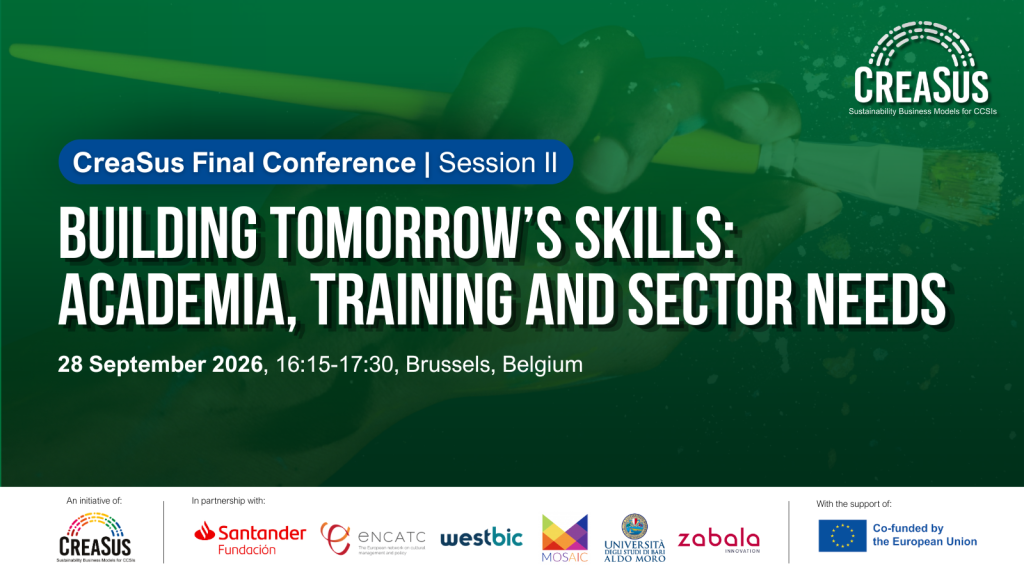
In the lead-up to the CreaSus Final Conference, we are taking a closer look at each session and the issues it will address. Taking place on 28 September 2026 from 16:15 to 17:30, Session II, Building tomorrow’s skills, will bring together universities, researchers, training providers, and European stakeholders to explore how research, education, and capacity building can equip CCSIs for the green and digital transitions.
The transition towards sustainability in the Cultural and Creative Sectors and Industries (CCSIs) requires more than innovative business models and technical solutions. It depends on people having the skills, leadership, and organisational capacity to embed sustainability in everyday decisions. Drawing on the experience and outcomes of CreaSus, this roundtable addresses one of the sector’s most pressing challenges: narrowing the gap between sustainability research and professional practice.
Throughout the project, CreaSus has developed practical resources to strengthen the sustainability and competitiveness of European CCSIs. These include a sustainability assessment framework, a roadmap outlining transformation pathways, and funding and business model toolkits, tested through pilot activities in Ireland, Italy, Greece, and Spain. These experiences show that frameworks and methodologies can only generate lasting change when organisations have the competencies and internal capacity to apply them.
Building on these findings, the session will examine how higher education institutions, training providers, researchers, and sector professionals can work together to address current skills gaps. It will identify the green, digital, soft, and managerial skills that will be critical over the next five years, as well as the research and training priorities needed to support circular, resilient, and competitive business models. The discussion will also explore how CreaSus outcomes can inform future education programmes, professional upskilling, and capacity-building initiatives, while considering how sustainability can become a source of innovation, long-term value, and competitive advantage rather than simply a regulatory obligation or additional cost.
Led and moderated by the Department of Economics, Management and Business Law (DEMDI) at the University of Bari Aldo Moro (UNIBA), the roundtable will translate these perspectives into concrete recommendations for higher education, professional development, capacity building, and stronger collaboration between academia and the cultural and creative sectors.
What we will explore:
- Which skills are currently lacking in CCSIs compared to those recommended by sustainability research, and how can universities help to bridge this gap?
- What soft skills and green skills will be essential over the next five years to make CCSIs business models truly circular and resilient?
- How can the results of CreaSus and similar projects be translated into concrete policies and training initiatives for the sector?
Key takeaways from the session
- A clearer understanding of the main skills gaps affecting the sustainability transition in CCSIs.
- Practical insights into the competencies needed to support circular, resilient, and competitive business models.
- Concrete ideas on how research projects such as CreaSus can influence education, policy, and capacity-building initiatives.
Turn sustainability ambition into practical action. Join the CreaSus Final Conference in Brussels on 28-29 September 2026 to discover tested tools, gain new insights from research, policy and professional practice, and connect with those working towards more resilient, competitive and sustainable CCSIs across Europe. Places are limited, so register now and secure your place.