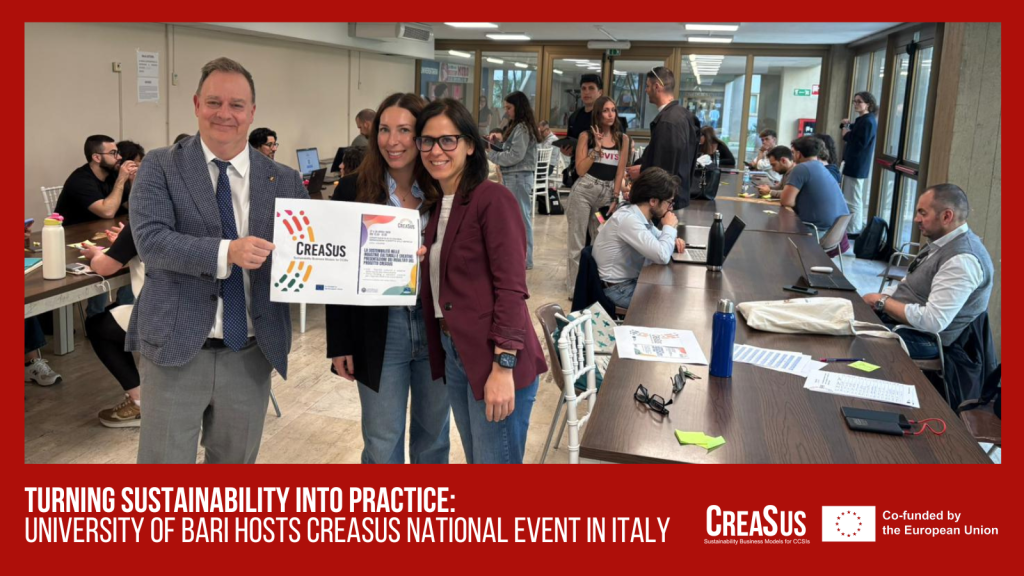
The University of Bari Aldo Moro hosted the CreaSus National Event in Bari (Italy) on April 27–28, 2026, as part of the EU-funded CreaSus project.
The event was organized by the Department of Economics, Management and Business Law (DEMDI). It represented an important opportunity to engage cultural organizations, sustainability managers, academics, and students in an interactive discussion on the role of sustainability in cultural and creative enterprises. The main objective was to support participants in shifting from a theoretical understanding of sustainability to a more practical and actionable approach, by providing them with concrete tools to integrate ESG (environmental, social, and governance) principles into their business models. Both days recorded strong participation, with approximately 70 attendees on the first day and around 60 on the second, highlighting the growing interest in sustainability and innovation within the cultural and creative sector. A distinctive feature of the event was the integration of gamification methodologies, designed and facilitated by Fleet Save, a company specializing in the creation of playful, narrative, and gamified experiences.
The first day (April 27, 2026) was organized into several key sessions. The event opened with institutional greetings from Director Prof. Grazia Dicuonzo, followed by Director of the Master’s Program in Tourism and Cultural Systems Planning and Management (PMSTC) Prof. Celeste Boccuzzi , from prof. Graziana Galeone (vice responsible of Creasus), the manager of Puglia Culture, Dr. Lino Manosperta and by two representatives of creative organizations: Fleet Save, with a testimonial from Dr. Giacomo Carlucci, and Breathing Art Company from Dr. Simona De Tullio. The opening session emphasized the strategic importance of sustainability for the development of cultural and creative industries (CCIs) and highlighted the role of the university in bridging research and practice.
This was followed by a presentation of the CreaSus project and its main outcomes by prof. Teodoro Gallucci (responsible of Creasus project). The focus was on the ESG assessment model developed for CCIs, as well as the self-assessment tool designed to help organizations evaluate their current level of sustainability, identify gaps, and define paths for improvement. One of the highlights of the day was the roundtable discussion featuring industry representatives. Experts in the field shared their experiences and perspectives, addressing both the challenges and opportunities associated with integrating sustainability into cultural and creative enterprises. This session fostered direct dialogue between participants and experts, enriching the learning experience with insights drawn from real-world contexts.
The final part of the day was dedicated to a fun quiz, which marked the first phase of the experiential learning process. Participants took part individually via their smartphones using a dedicated web application, developed specifically for this event by Fleet Save. The quiz focused on the 2030 Agenda and the content of the CreaSus project and was designed not as an assessment tool, but as a methodological tool for active learning. At the end of the activity, a final leaderboard was displayed, highlighting the participants who had achieved the highest scores. The ranking was based not only on the accuracy of the answers but also on response time, rewarding those who answered correctly and most quickly. This element introduced a dynamic and motivating competitive dimension, further increasing the participants’ attention and engagement. Overall, this first gamification format served as a cognitive activation phase, consolidating knowledge and preparing participants for the more complex, project-based activities of the second day.
The second day (April 28, 2026) focused entirely on hands-on, collaborative activities, shifting from knowledge consolidation to practical application and project design. Participants were divided into small teams (up to four members) and engaged in a cooperative, project-based gamification experience. Guided by Dr Rossana Strippoli, Prof. Graziana Galeone and Prof. Teodoro Gallucci, the participants designed a “Sustainability Project” based on the dashboard of indicators developed within the CreaSus project. The aim was to promote an entrepreneurial or creative start-up capable of generating economic, social, environmental, and cultural value.
The activity followed a step-by-step design process, prompting teams to define: the core idea, target users and needs, value proposition, sustainability dimensions, positioning and development potential.
This approach was inspired by business-oriented design methodologies, encouraging participants to integrate creativity with feasibility, market positioning, and impact generation. Participants were required to interact with the CreaSus platform’s ESG indicators and evaluation criteria, with the aim of transforming theoretical tools into practical design resources. This shift from “learning about” to “learning by doing” enabled participants to understand how ESG principles concretely drive decision-making, project development, and value creation. At the end of the session, each group presented its project. This phase served multiple purposes, including formalizing and structuring ideas, encouraging peer learning, and developing transversal skills such as teamwork, decision-making, and communication.
The second day concluded with final remarks, reaffirming the importance of initiatives such as the CreaSus project in supporting the transition toward more sustainable and resilient business models in the cultural and creative sectors. Overall, the CreaSus National Event represented a successful example of integration between academic knowledge, practical tools, and innovative methodologies. Through the combined use of theoretical sessions, expert discussions, and gamified learning experiences, participants were able to acquire both conceptual understanding and operational skills related to sustainability in CCIs.