What was the first motivation to design and propose CreaSus project?
Banco Santander Foundation has been providing financial support to many cultural organizations for more than 20 years. But for a few years now we wondered whether the impact of this economic aid was enough for the sector. We saw that cultural organizations needed support to tackle other societal and market challenges, not just the financial ones. That is why we began to assess how we could help them navigate the challenges of contemporary society; social, environmental and financial sustainability.
Furthermore, Banco Santander, the group to which we belong, is committed with sustainability. How could we, the Foundation, support cultural organizations that were not making a transition towards sustainability? At some point, the group could even demand that we ceased supporting cultural industries that were not working on the issue.
So we did a preliminary study, as a pilot, that would help us assess the state of the art, the challenges and opportunities for the cultural ecosystem in relation to sustainability. And indeed, we confirmed that there was a lot to do. Creasus made perfect sense.
From your experience, what are the current barriers and/or challenges for CCSIs to embed sustainability in their business models?
Cultural organizations live day to day. The precariousness of 90% of the sector makes it very difficult to address challenges such as sustainability. Logically these issues end up at the bottom of the priority list. That is why it is important to push from the outside, so that being sustainable becomes a real priority. It is also important to say that a very theoretical, poorly grounded discourse has been built around sustainability, which is often difficult to visualize, even if you intend to work on it.
How will CreaSus help CCSIs to integrate sustainability in their operations?
Creasus will make it easier for cultural organizations to take two essential first steps towards sustainability.
The first is to do a self-diagnosis on their performance in different sustainability areas. You can’t improve if you don’t know where you are. Just being confronted to what you should measure and understanding what counts and what doesn’t, will give you the beginning of the roadmap towards your transformation.
The second is to be part of an international work network in which other peer cultural agents are willing to make this self-diagnosis. Training to improve will indeed have to come later.
How does sustainability innovation become a competitive advantage?
There is a first obvious advantage, which is being able to opt for public and private economic resources that integrate sustainability aspects in the award criteria. Public calls increasingly incorporate this variable in their calls and other private funders, such as Banco Santander, are increasingly considering sustainability in their funding schemes.
Furthermore, as a cultural sector with enormous power to raise awareness, we have to be coherent. We program a culture that often speaks of social justice or ecologies while we often do not have those values incorporated into our internal practices.
What can we expect for 2024 and how stakeholders can get involved with CreaSus project?
We are looking forward to starting to collaborate with cultural organizations that want to participate in the Creasus project actions.
By the end of the year, we will begin contacting all of them to get them involved into the piloting of the project resources and listen to their opinions.
There will be different possibilities of involvement. Organizations can be part of the pilots but also participate in the consultation processes of developing the tool and the sustainability indicators.
Each of the members of the participating countries will be the link with their national cultural industries, but stayed tuned through our website and newsletter!
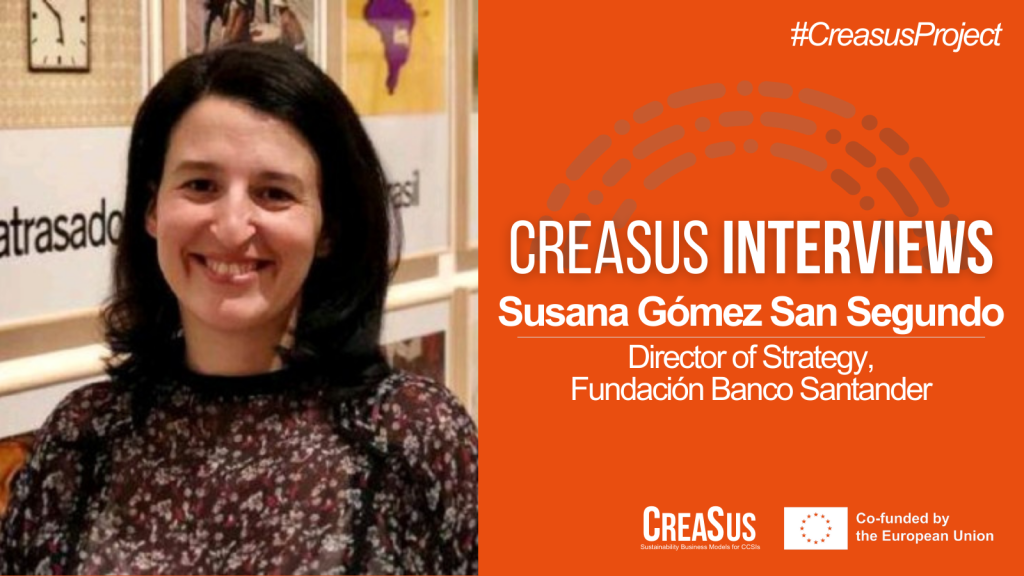
About Susana Gómez San Segundo
Extensive experience (more than 15 years) in the fields of foundations, philanthropy and culture. Specialized in the intersection between cultural management and social impact.
I’ve been always interested in technology and the way it can changes lives, and I’ve been lucky enough to apply that passion on my projects. I am always learning about governance, transparency and about public policy combined with private efforts. Since 2018, I am the Director of Strategy at Fundación Banco Santander, where I had been working since 2012 in communication, educational programs in cultural institutions, digital experience in creative sectors and social projects. My college studies set my career. I studied Humanities in Carlos III University (1997-2001) and a Master degree in Arts Management at the same institution (2003-2004). I’m still connected with the University teaching about communications, audiences and participation in culture since 2010.