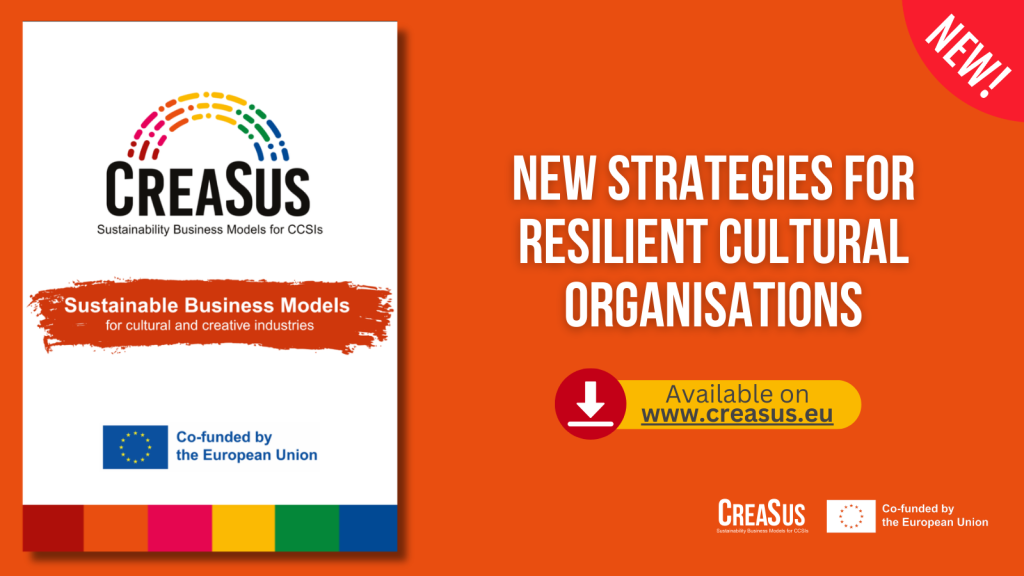
CreaSus has released a new report exploring how cultural organisations can develop sustainable business models for CCSIs.
Cultural organisations face increasing pressure. Public funding is shrinking in many countries. Audience expectations are evolving. Institutions are also expected to reduce their environmental impact and strengthen their social role.
These changes require new ways of thinking about how cultural organisations operate. Financial sustainability, environmental responsibility and social impact must now work together.
The new CreaSus report examines how organisations can redesign their business models to respond to these challenges. It focuses on practical strategies that support long-term resilience in the cultural sector.
Sustainability in cultural organisations goes beyond environmental action. It also includes social responsibility and strong governance structures. These three dimensions form the foundation of sustainable organisations.
Practical examples of sustainable business models for CCSIs
The report explores sustainable business models for CCSIs through concrete examples. It examines how sustainability can be integrated in three different types of cultural organisations: theatre companies, film production studios and museums.
For theatre companies, sustainability can be embedded throughout the production process. Eco-friendly set design, reuse of materials, energy-efficient lighting and digital ticketing can significantly reduce environmental impact. These measures can also lower production costs.
Film production companies can adopt similar approaches. The report highlights strategies such as renewable energy on film sets, reduced travel emissions and digital distribution. These measures help limit the environmental footprint of film production.
Museums also have many opportunities to integrate sustainability into their operations. Energy-efficient buildings, reusable exhibition systems and digital collection management can reduce resource consumption while strengthening the educational mission of cultural institutions.
The report also emphasises the importance of measuring progress. Cultural organisations should monitor indicators such as carbon emissions, energy consumption, waste reduction and audience engagement. These indicators help organisations evaluate and improve their sustainability performance.
Lessons from cultural organisations leading the transition
The publication also includes a case study of Teatro Real in Madrid. Over the past decade, the opera house has transformed its operating model.
Teatro Real reduced its dependence on public funding and diversified its revenue streams. At the same time, it introduced energy-efficient technologies and sustainability initiatives.
Today, the institution generates most of its income independently while maintaining high artistic standards. Its experience shows that sustainability and financial resilience can reinforce each other.
The CreaSus report demonstrates that sustainable business models for CCSIs are achievable. Cultural organisations can integrate sustainability into their strategy, operations and programming. When they do so, sustainability becomes a driver of innovation, resilience and long-term impact.
Read the full report here.